
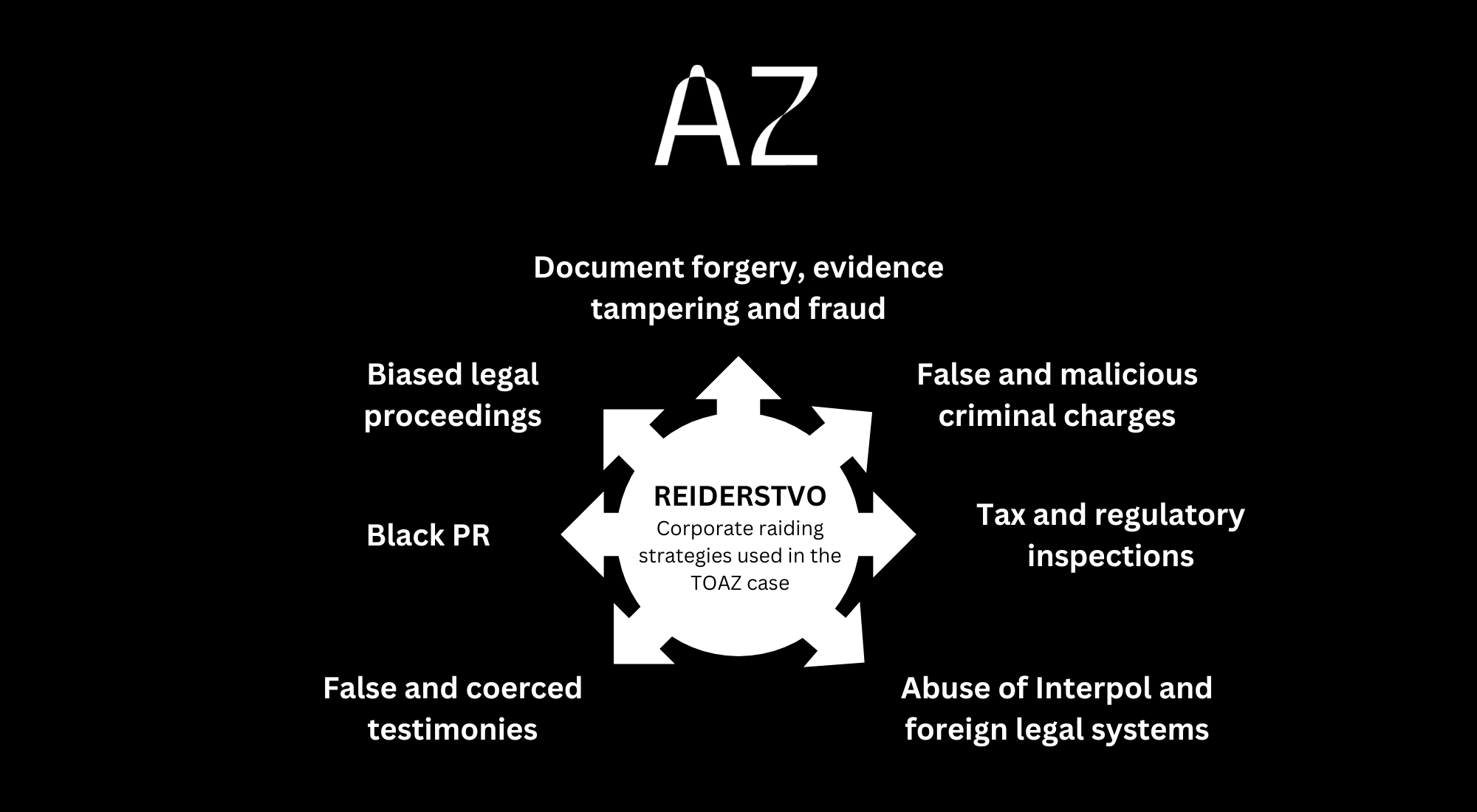
The corporate raid on TogliattiAzot (ToAZ) is an important case study
What is happening to the BKITs, TogliattiAzot (ToAZ), as well as its current and former management is a blatant example of “Reiderstvo.” Reiderstvo is a type of illegal corporate takeover which is endemic in Russia.
Reiderstvo is a form of corporate raiding which is particularly aggressive and relies heavily on exploiting the weaknesses and corruption in Russia’s law enforcement and judiciary.
Russian corporate raiders take advantage of these institutional weaknesses to launch full scale attacks against any business they wish they take over.
TogliattiAzot has long been a victim of attempted corporate raids due to its economic success, the value of its assets and its strategic role in the Russian economy. If successful, Dmitry Mazepin’s raid would enable him to control a large share of the Russian fertilizer industry and the global fertilizer market.
Large companies are not the only the victims of reiderstvo. Small businesses with few resources to protect themselves are the most common target.
Public organizations, such as schools, universities, hospitals, museums and theatres, are often raided, particularly if they sit on valuable real estate.
Even private apartment raiding has become popular and profitable.
The tactics used in corporate raiding are numerous and vary depending on the scale and viciousness of the attacks.
In the ToAZ case, however, almost every single corporate raiding tactic ever used has been leveraged as part of Dmitry Mazepin’s attempts to seize control of the company. Thus, the TogliattiAzot affair serves as a useful case study to highlight and expose the methods used in illegal corporate raiding, and their consequences for the victims and for Russia in general.
Biased legal proceedings
Background
An important component of any corporate raid is securing the cooperation of judges in order to ensure that legal proceedings, be they civil or criminal, are tried in a way that limits the victim’s ability to defend themselves and ensures a favourable ruling for the raiders. Judges in Russia have broad discretion over their cases, and are able to shape proceedings in favour of one party over another through various tactics such as the use of anonymous witnesses, barring the defence from calling witnesses, supressing evidence, supressing counsel for the defence, etc.
Use in the ToAZ case
Many of the tactics described above were used in the criminal case that ultimately resulted in the July 2019 ruling of the Komsomolsky District Court of Togliatti finding Vladimir Makhlai, Sergei Makhlai, Evgeny Korolev, Beat Ruprecht and Andreas Zivy guilty of fraud in relation to the ‘Nitrochem scheme’ alleged by Uralchem.
For example:
The ‘file author’ listed on the original electronic copy of the indictment handed to the defence on a flash drive was from Uralchem Management Company, indicating that the indictment was written by Uralchem and not by the investigative team.
The prosecution relied heavily on anonymous witnesses, making it impossible for the defence to cross-examine them or disprove their testimonies.
During the trial, multiple witnesses put forward by the prosecution claimed that evidence submitted by the prosecution was faked.
ToAZ representative Denis Simachev told the court that Major General Mikhail Tumanov of the Investigative Committee attempted to bribe defence counsel to serve as an informant. When he refused, Tumanov threatened him with trouble, including potentially initiating a criminal case against Simachev personally for interfering with the investigation.
The judge limited the defence’s ability to present its own witnesses, demanding a full list of witnesses in advance as well as justification as to why their testimony would matter. Similar demands were not made of the prosecution, and no advanced list or justifications were provided by them.
The judge raised the idea of cancelling all further questioning of defence witnesses because the full list of witnesses was not provided and those who already testified “aren’t reporting anything new”, essentially depriving ToAZ of the right to present further evidence.
Nikolai Kazantsev, an expert who originally worked on the expert report on ToAZ pricing, was removed after finding no irregularities. He told the court that the head of his research institute attempted to force him to include data from unknown experts, and that the case materials he used to make his judgment were stolen from his office before he was suspended from the case.
The court refused to have the authors of the final expert report questioned in court.
Uralchem petitioned to include 14 civil respondents in the case in November 2018. The court noted at the time that it would take at least 6 months to notify all of them, and that they will have the right to become familiar with case materials and have files translated to other languages.
The same judge then for all intents and purposes barred multiple civil defendants from full participation in the trial by refusing time to translate documents or review case materials, despite being notified about the case after all witnesses for the prosecution had already been questioned.
Lawyers for the defence were not able to participate in hearings for multiple reasons, including not being granted business visas and because the hearing schedule had been expedited, requiring lawyers be available every working day to participate in the case, despite representing other clients.
The judge notably announced on May 16th that the proceedings were moving on to the oral arguments stage, despite the fact that the schedule stated that this stage would not begin until June 21.
The following tactics are commonly used in corporate raiding:
Document forgery, evidence tampering and fraud
Background
The use of forged or sham documents is one of the most common tactics used in reiderstvo. Raiders falsify corporate documents, such as share registers, contracts and permits, and then bribe, coerce or mislead public officials into having these fake documents notarised or otherwise recognised as legally valid. Document forgery is also used to complement another raiding tactic – the seizure and destruction of corporate documents by law enforcement authorities. In such cases, forgeries can then be used to “replace” the destroyed documents and therefore “prove” the raiders’ ownership of the target company or assets.
Use in the ToAZ case
Forged or sham documents were used multiple times in the corporate raiding attempts on ToAZ, and as early as 2006 during the first raid by Viktor Vekselberg’s Tringal Equities, which launched civil proceedings against ToAZ and the company’s Board of Directors based on forged letters.
Forged documents were also used by Eurotoaz in its attempts to claim a shareholding in the company in 2014, and by Evgeny Sedykin in organizing sham shareholders’ and Board meetings in 2015.
Moreover, in January 2018, Sergei Sokolov revealed that he was hired to fabricate evidence linking ToAZ General Director Vyacheslav Suslov and ToAZ Finance Director Nikolai Neplyuyev to allegations of terrorism. Sokolov further admitted that he was hired “because our customers wanted to get something that didn’t belong to them.”
False and malicious criminal charges
Background
The use of fabricated criminal charges is another core component of most corporate raids in Russia. Forged documents, coerced testimonies or “investigative” black PR articles can be used by corrupt officials as the justification for opening a criminal investigation into the victims of a raid, usually alongside one or more civil claims by the corporate raiders.
These criminal investigations aim to pressure the management of the raided company into giving up control of the company or its assets, or to otherwise limit their ability to fight back against a corporate raid. Investigations also provide an excuse for the seizure of corporate documents, which can then be passed on to the raiders. When the victims of a raid are based abroad, malicious criminal charges can also be used to initiate extradition proceedings against them.
Use in the ToAZ case
The use of criminal charges to support the corporate raiding attempts against ToAZ has been a constant and ongoing tactic. Bogus criminal charges have accompanied each raiding attempt, with varying objectives. For example, the apparent purpose of the Investigative Committee’s investigation into ToAZ starting in February 2012 was to carry out searches of ToAZ’s offices in order to seize many of the corporate documents which Uralchem had been unlawfully trying to obtain. Successive attempts to extradite the current and former managers of the company were also turned down by British courts due to the political and biased nature of the extradition requests and of the criminal proceedings on which they were based.
Tax and regulatory inspections
Background
In certain cases, corporate raiders use bribes to harass their victims through repeated, intrusive inspections by regulatory authorities (e.g. tax, environmental standards, employee safety etc.). The inspections can also be used to support malicious criminal or civil claims, or to contribute toward black PR campaigns aimed at damaging the victims’ reputations.
Use in the ToAZ case
Inspections by various local and national authorities and agencies have been used to support various criminal cases, to seize corporate documents and hand them over to the raiders, and to generate news stories tarnishing the reputation of the company and of its current and former management.
False and coerced testimonies
Background
Criminal and civil proceedings initiated as part of a corporate raiding attempt are often supplemented by false or coerced testimonies. Moreover, in some cases, courts friendly to the corporate raiders may allow the use of anonymous witnesses, which is highly unusual and makes it impossible for the defence to cross-examine or disprove testimony.
Use in the ToAZ case
Attempts to secure false and coerced testimonies have occurred regularly in the ToAZ case. For example, in June 2019, Alexander Popov, the Head of TogliattiKhimBank was arrested on trumped up charges and held in prison in an attempt to force him to testify against ToAZ.
Similarly, in May 2019, a witness for the defence in the criminal case against former managers of ToAZ and current managers of Nitrochem and Ameropa stated that representatives from Uralchem had attempted to bribe ToAZ employees to serve as witnesses for the prosecution, and threatened those who refused with reprisals. In the same criminal case, it emerged that the prosecution relied heavily on anonymous witness, which were allowed by the court despite the obvious concerns expressed by the defence as to their legitimacy.
Abuse of Interpol and foreign legal systems
Background
When the victims of a raid are located abroad, the raiders seek the support of the Russian judiciary and law enforcement authorities to secure international arrest warrants through INTERPOL, leveraging a well-known flaw in the organisation’s “red notice” system. Red notices effectively prevent individuals from travelling outside of their country, and are used to make victims live in constant fear of arrest and extradition.
Use in the ToAZ case
INTERPOL red notices were imposed at Russia’s request against five individuals targeted by Dmitry Mazepin and Uralchem as part of their raid on ToAZ. The red notices were eventually removed by INTERPOL, and none of the individuals in question were ever extradited.
Black PR
Background
Black PR is a broad term which refers to a range of strategies and tactics to damage the reputation of an individual or a company. Damaging the reputation of a raid’s victims is crucial to ensure that a raid is not opposed too strongly by employees, citizens, NGOs and other groups, and to give corrupt law enforcement authorities a plausible excuse to open investigations against the victims. Black PR campaigns are often carried out by specialised firms, which write false stories about the target company or individuals and publish them on paid-for websites, blogs, social media and forums. In some cases, black PR campaigns also involve setting up fake pressure groups and organisations to generate false complaints or reports. New investigations or office raids can, in turn, fuel further negative media coverage of the victims.
Use in the ToAZ case
The use of black PR has been a central tactic in Dmitry Mazepin’s raiding attempts against ToAZ for over a decade, and continues to this day. Fake stories circulating on paid-for publications are regularly used to spread disinformation about ToAZ’ safety and environmental record, and lies about the former and current managers of ToAZ who have been targeted by Uralchem. These stories are then spread through social media, and in some cases are unwittingly picked up by legitimate, regional, national or international news media.
The Black PR campaign against ToAZ also involves the use of fake environmental NGOs and advocacy groups, which fabricate and spread allegations with the aim of having them reported in the press. While difficult to measure accurately, the scale of the smear campaign waged by the raiders is massive. In March 2013, leaked emails published online showed that the campaign involved fabricating a number of allegations, such as environmental damage and tax evasion, and spreading them mainly through paid-for websites.